

Your NPS scores dropped four points last quarter.
You know the number. You don't know the number behind the number. What changed? Which customers? Which part of the experience? Was it a product issue, a service failure, a pricing move, or something that happened in the market that had nothing to do with you at all?
The score is easy to track. The sentiment driving it is what actually tells you what to do.
Consumer sentiment is what research is ultimately trying to get at. Not just what customers do, but how they feel about it, why they feel that way, and whether that feeling is drifting in a direction that should worry you. The problem was never that sentiment doesn't exist in the data. It's always been that pulling it out accurately, across thousands of responses, fast enough to act on it, was genuinely hard to do.
Online market research tools changed what's possible. AI changed what's practical. Together, they've changed how organizations understand their customers in something close to real time.
What Consumer Sentiment Actually Means in a Research Context
Sentiment sounds simple on paper. Customers are happy or unhappy. They like your product or they don't.
In practice, it's layered. A customer can be satisfied with your product and frustrated with your service. They can be enthusiastic about a feature and completely confused about how to use it. They can be loyal despite a complaint, or quietly on their way out the door despite handing you a positive survey score last month.
Measuring sentiment properly means capturing all of those layers, not just the top-line number. It also means tracking how they shift over time, across different segments, in response to specific events. Sentiment isn't static. It moves, and the movement is usually more telling than the absolute level.
Traditional research was never well-suited to catching that movement. A survey run once a quarter gives you a quarterly snapshot. It doesn't tell you when sentiment shifted, what triggered it, or which customers were affected first. By the time the data reaches your hands, the window to intervene has often already closed.
The Shift to Online Research Tools
Online market research tools knocked out several of the structural constraints that made sentiment research slow and expensive.
Fieldwork that once took weeks to complete now runs in hours. Surveys that required physical or phone contact now reach global samples digitally. Data that once had to be manually entered and cleaned arrives structured and ready to analyze. The logistics that used to eat research budgets are now handled by the platform, which means more of the budget goes toward the analysis rather than the mechanics of collection.
But speed and scale alone don't solve the sentiment problem. Collecting data faster just means more data to make sense of, and making sense of it was always the hard part.
That's where AI comes in.
How AI Reads Sentiment at Scale
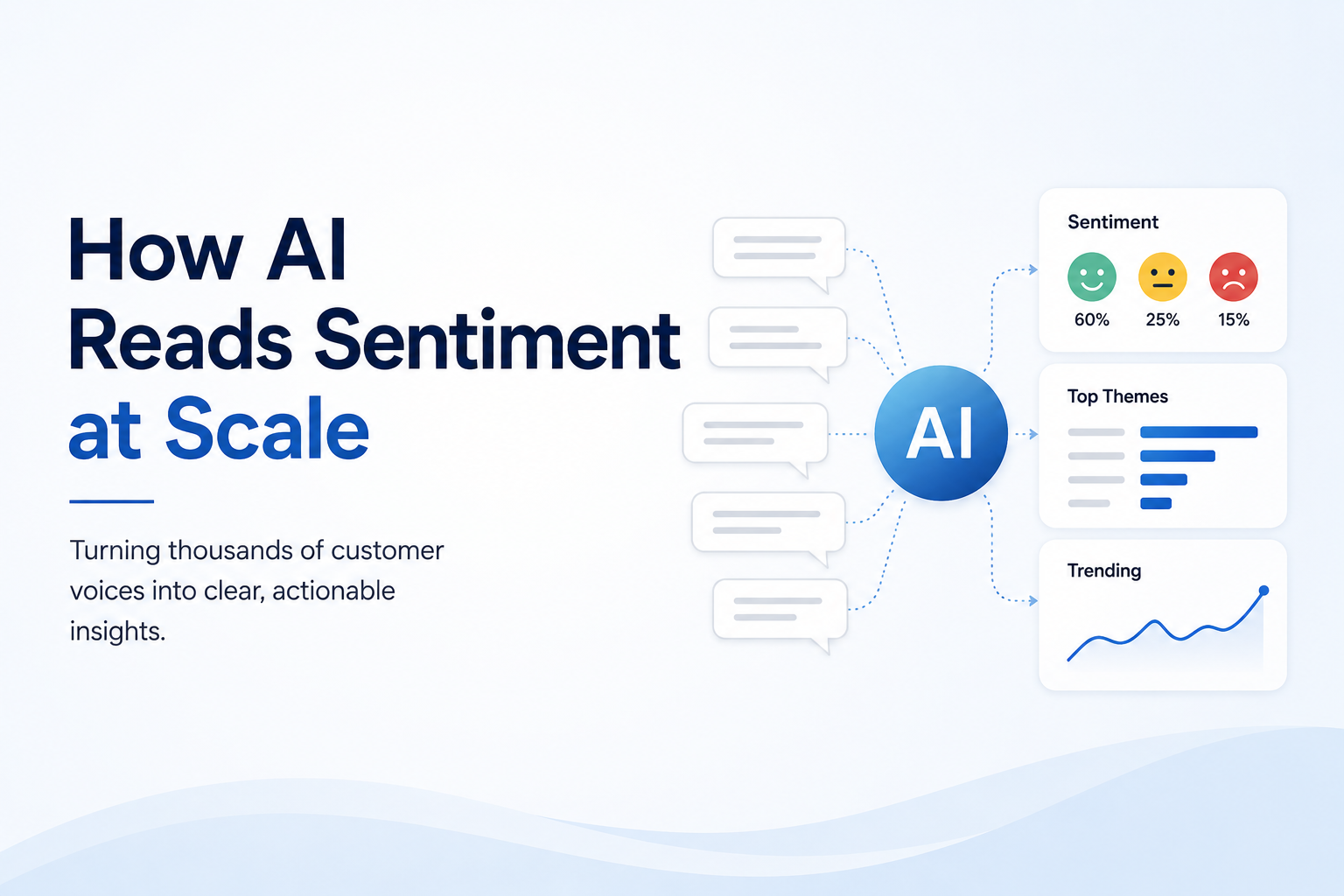
The core thing AI brings to sentiment analysis is the ability to read language the way an experienced researcher would, but across thousands of responses at once, without the inconsistency that creeps in from human fatigue, shifting frame of reference, or the hypotheses a researcher carried into the analysis.
Here's what that looks like in practice.
Open-End Analysis
Open-ended survey responses have always been the richest source of sentiment data and the hardest to actually use. A survey with 2,000 respondents and three open-ended questions generates 6,000 text responses. A research team can read a sample. AI reads all of them, finds the themes, counts how often each one appears, measures the sentiment attached to each, and flags the responses with the most signal.
What used to sit in an appendix that clients skimmed becomes a structured, searchable, quantified dataset. The verbatims that got maybe five minutes of attention in a traditional debrief now drive the finding.
Sentiment Scoring Beyond Positive and Negative
Basic sentiment analysis puts responses in three buckets: positive, negative, neutral. That's fine for a top-line read. It misses most of what the language actually contains.
More capable AI goes further. It identifies the specific part of the experience the sentiment is directed at: product quality, customer service, price perception, brand trust, onboarding, the checkout flow. A response that reads positive overall but contains real frustration about a specific feature doesn't show up as negative in basic scoring. Aspect-level analysis catches it.
This matters because the actionable insight is almost never in the overall score. It's in the specific thing driving it.
Emotion Detection
Beyond positive and negative, customers express a range of emotions: frustration, confusion, delight, disappointment, enthusiasm, distrust. These predict behavior in different ways. A confused customer is a support ticket and a churn risk. A frustrated customer is a complaint waiting to be filed. A delighted customer is a referral waiting to be asked.
AI trained on emotional language patterns can classify responses not just by direction but by emotional type. That distinction changes what you do with the finding. "High negative sentiment in this segment" is a flag. "High confusion in this segment, concentrated around the onboarding flow" is something you can actually fix.
Social Listening and Unsolicited Feedback
Customers don't only express sentiment when you survey them. They do it in reviews, in social posts, in community forums, in support tickets, in sales call transcripts. Most of this data already exists inside organizations. Most of it never gets analyzed in any systematic way.
Online research tools with AI integration pull these sources together and apply the same sentiment framework across all of them. The result is a picture of sentiment that's continuous rather than periodic, and that captures what customers say when they're not being asked, which is often more honest than what they say when they are.
An App Store review written in genuine frustration tells you something a customer service survey optimized for positive responses often won't.
Trend Detection Over Time
A single sentiment measurement tells you where you are. Sentiment tracked over time tells you where you're heading and what moved you there.
AI-powered trend analysis picks up when sentiment starts to shift before the shift becomes a crisis. A two-point drop in product satisfaction over six weeks, concentrated in one customer segment, following a specific product release, is a very different situation from a two-point drop spread evenly across all segments with no obvious trigger. The number looks the same in both cases. The story is completely different.
Catching the directional shift early is what makes sentiment data worth having.
Where Online Tools Have the Clearest Advantage
A few use cases show where AI-powered online research tools change the outcome, not just the timeline.
Brand Perception Tracking
Brand sentiment is hard to measure well because it changes gradually and the signal is scattered across multiple touchpoints. A quarterly tracker gives you four data points a year. By the time a brand perception problem surfaces in a quarterly report, it's been building for months.
Continuous sentiment monitoring across survey data, reviews, and social listening gives you a picture that updates in near-real time. You see the shift when it starts, not six weeks after it has compounded into something bigger.
Product Feedback Loops
Product teams need to know how customers respond to changes fast enough to adjust, not six weeks later. AI-powered sentiment analysis on post-launch survey responses, in-app feedback, and support ticket language gives product teams a continuous read on how specific features are landing, which segments are struggling, and where usability problems are concentrated.
That kind of feedback loop changes product development from periodically research-informed to continuously customer-informed.
Customer Experience Measurement
Customer experience sentiment doesn't live in one place. It lives in post-purchase surveys, NPS responses, customer service interactions, churn interviews, renewal conversations. Measuring it properly means pulling all those signals together and reading them against each other.
AI-powered platforms do this automatically. The customer who gave you a high NPS score three months ago but has sent four frustrated support tickets since then is a churn risk that a survey-only view of sentiment would miss entirely.
Competitive Sentiment Intelligence
Customers talk about your competitors in your research, if you let them. Open-ended responses regularly contain comparisons: "I wish it worked more like X" or "we switched from Y because..." AI can pull these signals out at scale and turn them into structured competitive intelligence. In traditional research this either required a separate dedicated study or got left sitting in verbatims that nobody coded systematically.
The Data Quality Problem Nobody Talks About Enough
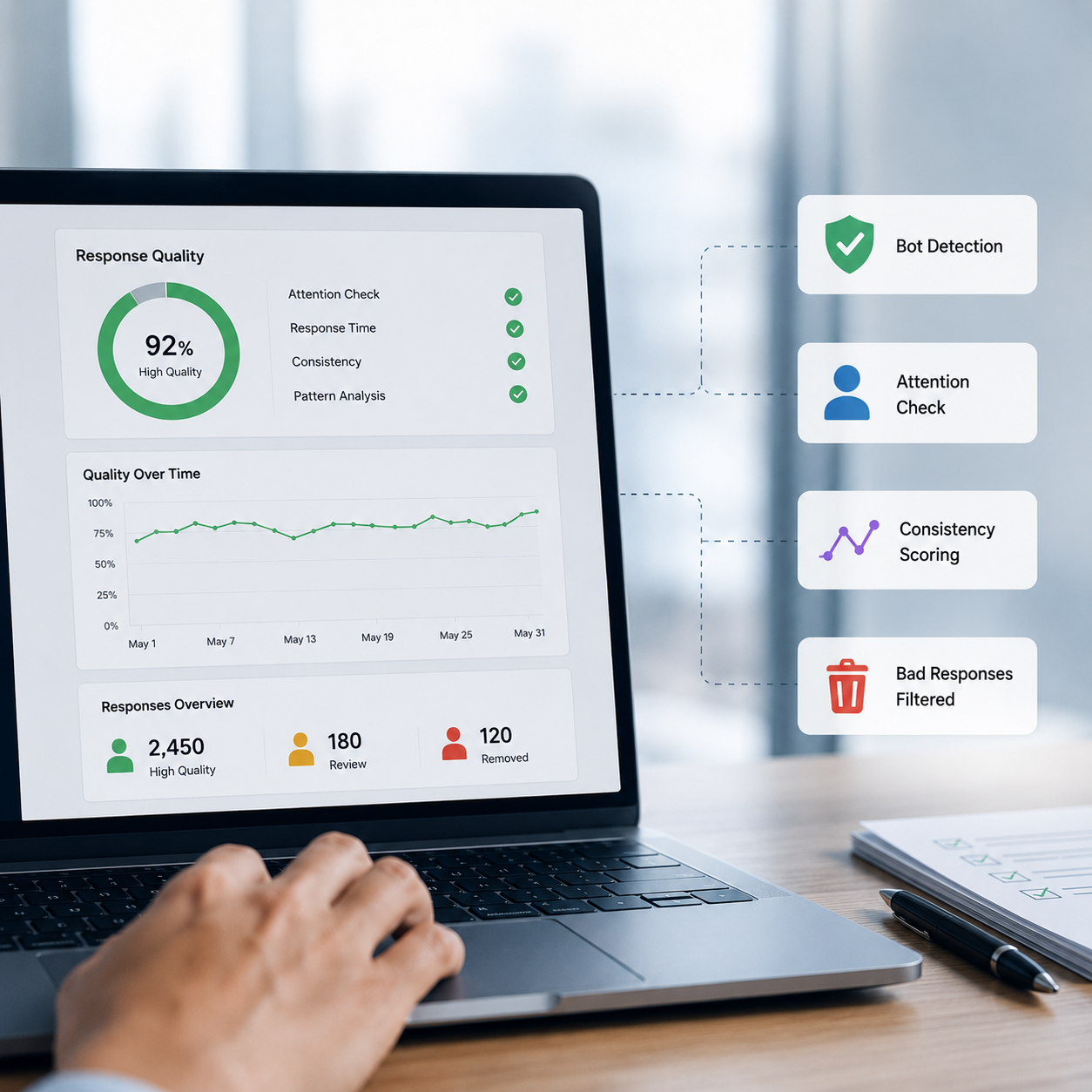
Sentiment analysis is only as good as the data underneath it. And online research has a data quality problem that AI also helps address.
Survey responses collected online are vulnerable to bots, inattentive respondents, and straight-liners who click through without reading. These responses don't just add noise. They actively distort the sentiment picture. A bot generating plausible-sounding open-ended text will pass human review more often than researchers like to admit.
AI-powered data quality monitoring catches these issues during fieldwork, not after. Response pattern analysis, attention check validation, consistency scoring across related questions, behavioral bot detection: all of it runs as responses come in. Bad responses get flagged and replaced before they enter the dataset rather than after they've already skewed the scores.
Clean sentiment data is the foundation. Everything built on top of it is only as reliable as what's underneath.
What Good Sentiment Analysis Actually Produces
The output of well-executed sentiment analysis isn't a sentiment score. That's the start of a conversation, not the end of one.
The output is understanding: which customers feel which way about which parts of their experience, how that's changing, and what's driving the change. That connects directly to decisions: what to fix, what to invest in, which segment to prioritize, what the customer experience team should focus on this quarter, what the product roadmap should reflect.
Sentiment analysis that doesn't connect to a decision is just analytics for its own sake. The platforms that do this well build the bridge between sentiment output and business action into the interface itself, so the finding and its implication arrive together rather than requiring a researcher to manually explain the gap.
Frequently Asked Questions
What is consumer sentiment analysis in market research?
Consumer sentiment analysis is the process of identifying and measuring how customers feel about a brand, product, or experience, not just what they do or say on the surface. It goes beyond satisfaction scores to capture emotional tone, specific concerns, and directional shifts in how customers perceive their relationship with a company. In a research context, it typically draws on survey responses, open-ended feedback, reviews, and other customer-generated text, using AI to process that language at a consistency and scale that manual analysis can't reach.
How do online research tools collect sentiment data?
Through several channels running simultaneously: structured surveys with rating scales and open-ended questions, in-app feedback, review platform integrations, social listening feeds, and customer service interaction data. The most capable platforms combine multiple sources, which produces a more complete picture than any single channel can. AI then processes the language across all of those inputs, identifying themes, scoring sentiment, and tracking change over time without needing a separate manual analysis step for each source.
Can AI sentiment analysis understand nuance and context?
Better than most people expect, though the quality of the AI matters a lot. A general-purpose language model applied to customer feedback catches obvious positive and negative sentiment but misses subtler signals: the customer who says "it works fine" meaning they're disappointed, the response that reads positive overall but contains a specific buried complaint, the tone shift in a segment that signals an emerging problem before it shows up in the scores. A market research-specific AI, trained on the language patterns that appear in customer feedback, handles these nuances considerably better. The gap between a general model and a purpose-built one is most visible in the edge cases. In research, the edge cases are often where the important signals live.
How is real-time sentiment tracking different from traditional brand trackers?
Traditional brand trackers run periodically, quarterly or monthly at best, and give you a snapshot of where sentiment stood at the time of fieldwork. By the time the data is collected, analyzed, and delivered, the moment it was measuring is weeks in the past. Real-time sentiment tracking monitors continuously across survey responses, reviews, and other data sources, and flags directional shifts as they happen. This changes sentiment from a retrospective measure to an early warning system. You're not discovering that something changed six weeks ago. You're seeing the change as it happens, while there's still time to respond to it.
What is aspect-based sentiment analysis and why does it matter?
Aspect-based sentiment analysis identifies not just whether a response is positive or negative overall, but which specific part of the experience that sentiment is directed at: the product, the pricing, the customer service, the onboarding, the interface. This matters because overall sentiment scores average across all of those dimensions, which means they can stay stable while a specific problem is quietly getting worse. A customer who loves your product but hates your support process might give you a neutral overall rating that hides a real issue. Aspect-based analysis surfaces it without waiting for it to drag down the top-line number.
How do online research tools handle data quality in sentiment analysis?
Data quality in online research is a persistent challenge because digital collection is vulnerable to bot responses, inattentive respondents, and straight-line answering. AI-powered platforms address this through real-time monitoring during fieldwork: behavioral pattern detection, attention check validation, response consistency analysis, and bot detection that runs as responses come in rather than in a cleanup step afterward. The practical result is that the sentiment data reaching analysis is clean because problems were caught during collection, which produces more reliable scores than post-field cleanup typically achieves.
InsignAI is a full-stack, AI-native market research platform with a dedicated Market Research LLM, built to turn customer sentiment into decisions your team can act on the same day.