

A customer gives you a four out of five rating.
You file it under "mostly satisfied" and move on. But the open-ended comment underneath it says: "It's fine, I guess. Not really what I expected when I signed up." That's not a four out of five. That's someone who already has one foot out the door, using polite language to say so.
The number lied. The words didn't.
This is the core problem with measuring customer emotion through scores alone. Numbers are clean and comparable, but they flatten the texture of what customers actually feel. A four from someone who loves your product but had one bad support call is not the same four as someone quietly losing faith in the whole thing. They look identical in a spreadsheet. They are completely different customer situations.
AI sentiment analysis exists to read what the numbers miss. Not to replace measurement, but to go underneath it, into the language customers use, and pull out what they're actually feeling with enough consistency and scale to do something about it.
Why customer emotion is hard to measure accurately
Emotion doesn't travel cleanly into survey responses. Customers don't usually write "I am frustrated with your onboarding." They write "took me a while to figure out" or "not super intuitive" or, if they're really disengaged, they just put "fine" and move on.
Reading those signals accurately requires understanding context, not just vocabulary. The word "fine" is technically neutral. In customer feedback, it's almost never neutral. It usually signals resignation, mild disappointment, or the kind of passive dissatisfaction that doesn't generate complaints but does generate churn.
Human researchers can read this. A good analyst who has spent years with customer verbatims develops an instinct for the language of quiet dissatisfaction. The problem is that human analysis doesn't scale. You can train a researcher to read emotional subtext in 50 responses. Reading it in 50,000 responses with the same consistency is a different problem entirely.
That's the gap AI sentiment analysis closes.
What AI sentiment analysis actually does
At its most basic, AI sentiment analysis reads text and classifies the emotional tone: positive, negative, or neutral. That baseline is useful for getting a quick temperature check on large volumes of feedback. It's also where the less capable tools stop.
The more meaningful capability is what happens past that basic classification.
A properly built sentiment analysis system doesn't just assign a direction to a piece of text. It reads for the specific emotion behind the language. Frustration, confusion, disappointment, delight, distrust, enthusiasm: these are different emotional states that predict different customer behaviors, and treating them all as variations of positive or negative misses most of what the language contains.
It also reads for what the emotion is directed at. A customer who loves your product and hates your support team is not simply "mixed sentiment." They're positive on one very specific aspect of their experience and negative on another. A system that collapses those into a single score will tell you the customer is neutral, which is wrong in a way that makes the finding useless.
The best systems do both simultaneously: classify the emotion type and identify the aspect of the experience it's attached to. That combination is what makes the output actionable rather than just descriptive.
How AI learns to read emotion in language
The foundation is a language model trained on large amounts of text, enough to learn how emotional states map onto linguistic patterns. Not keyword lists, which were how the earliest sentiment tools worked and why they were famously bad at sarcasm. Actual pattern recognition across sentence structure, word choice, context, and the way meaning shifts depending on what surrounds a phrase.
The difference between a general-purpose language model and one trained specifically on customer feedback is significant, and it's worth understanding why.
General models learn from a broad mix of text. News articles, books, forums, social media. The emotional language in customer feedback doesn't behave like any of those sources. Customers writing in surveys are often trying to be polite while signaling something negative. They're constrained by response boxes. They use industry-specific shorthand. They understate strong feelings far more often than they overstate them.
A model trained specifically on customer research data, on thousands of real survey responses, support tickets, and review texts, learns these patterns. It knows that "not the easiest to navigate" in a usability response is more negative than the words suggest. It knows that "I'd recommend it to some people" in an NPS open end is not an endorsement. It calibrates to the register of customer language rather than applying general-text emotional norms to something that doesn't follow them.
This is the difference between a sentiment tool that produces plausible output and one that produces accurate output.
The emotional states that matter most in research
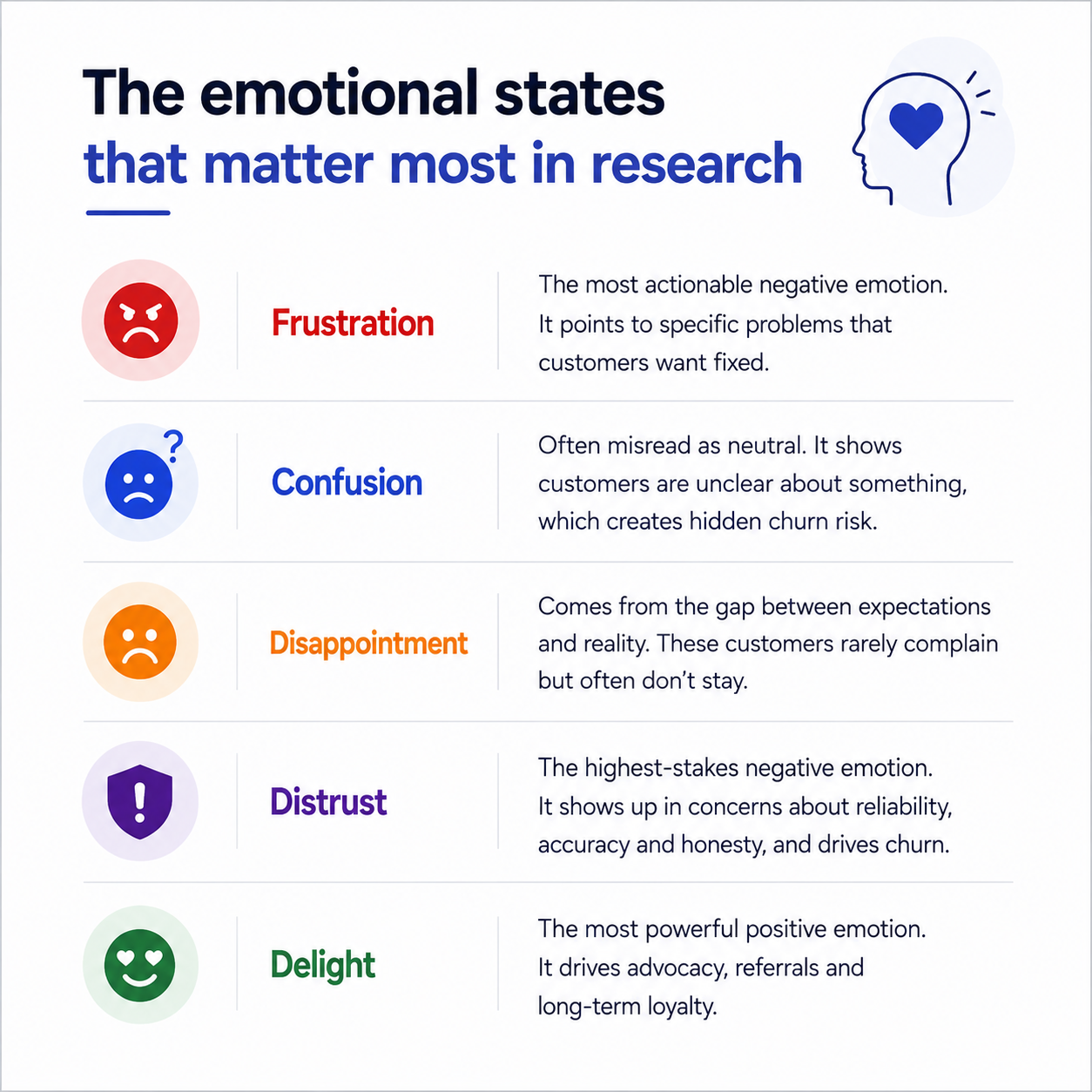
Not all emotions carry equal weight for business decisions. Some emotional signals in customer feedback are more predictive of behavior than others, and knowing which ones to look for changes how you design research and what you do with the output.
Frustration is the most actionable negative emotion in most contexts. Frustrated customers have a specific grievance. They haven't given up yet, which means there's usually something to fix. Frustration in post-launch feedback points directly at usability problems. Frustration in support ticket language points at service gaps. The signal is specific enough to respond to.
Confusion often gets misread as neutrality because it doesn't always sound negative. Customers who are confused tend to describe experiences rather than evaluate them. "I wasn't sure where to go" or "kept clicking around" are confusion signals that don't register as negative in basic sentiment classification. They're churn risks in disguise.
Disappointment is quieter than frustration and harder to catch. It often shows up in the gap between what customers expected and what they experienced, and it tends to use comparative language: "I thought it would," "I was hoping for," "compared to what I expected." Disappointed customers are less likely to complain and more likely to simply not renew.
Distrust is the highest-stakes negative emotion and the one most likely to drive immediate churn. It shows up in language about reliability, accuracy, and honesty: "not sure if I can rely on," "felt like it was misleading," "can't tell if the data is right." This emotion needs to be caught fast because customers experiencing distrust are usually already looking for alternatives.
Delight on the other side is worth tracking separately from general satisfaction because it's the emotion most associated with organic advocacy. Delighted customers don't just renew. They refer. Identifying what creates genuine delight rather than mere satisfaction tells you what to double down on, not just what to fix.
Where emotion detection changes research outcomes
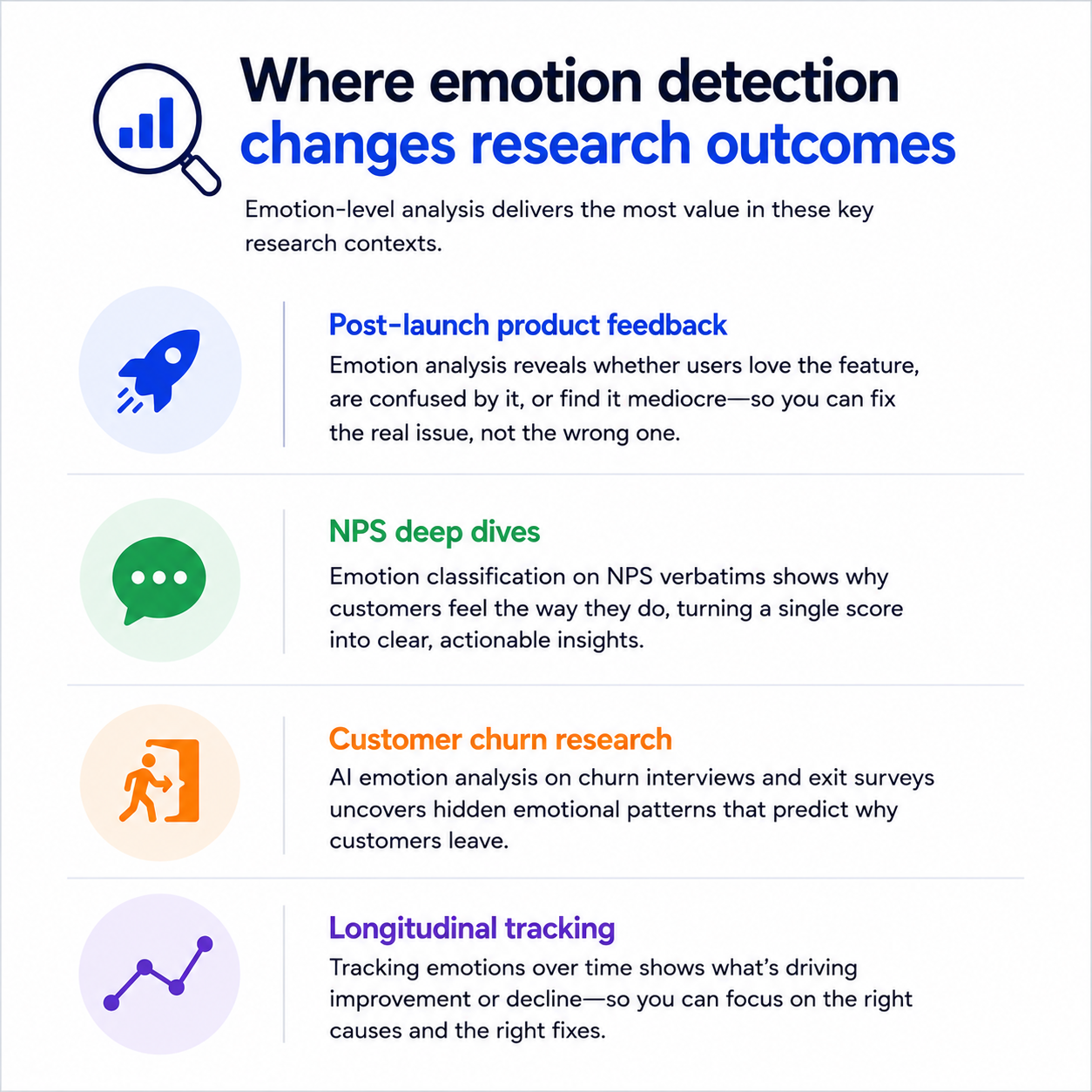
The practical value of emotion-level analysis shows up most clearly in a few specific research contexts.
Post-launch product feedback
When a feature ships, the first round of user feedback usually produces a mix of satisfaction scores that don't tell you much. A 3.8 average rating on a new feature could mean it's mediocre, or it could mean half the users love it and half are genuinely confused by it. Those require completely different responses.
Emotion analysis on the open-ended feedback tells you which situation you're in. High confusion signals in one segment and high delight signals in another means the feature works but the onboarding around it doesn't. That's a specific problem with a specific fix.
NPS deep dives
NPS scores move slowly and are noisy at the individual level. The verbatims underneath them move faster and carry more specific information. The detractor who writes "honestly not sure I'll renew" is expressing something different from the detractor who writes "your competitor does this better." Both are detractors. One is expressing disappointment, the other is actively evaluating alternatives. The intervention required is completely different.
Emotion classification on NPS verbatims turns a blunt score into a segmented understanding of where you're losing customers and why.
Customer churn research
Exit surveys and churn interviews are among the most valuable data sources in any research program and among the most underutilized. Customers who have already left are often more candid than customers still in the relationship, and the emotional tone of their language is particularly informative.
AI emotion analysis on churn interview transcripts and exit survey open ends finds patterns that manual coding at small sample sizes misses. The emotional signal that shows up across eighty churn interviews but only registers as a theme when you're reading all eighty, not a sample of twenty, is exactly the kind of thing that changes a retention strategy when you finally see it.
Longitudinal tracking
Satisfaction scores tracked over time tell you whether things are getting better or worse. Emotion signals tracked over time tell you how they're getting better or worse, and what's driving the direction.
A brand that sees frustration signals declining while confusion signals hold steady is solving a different problem than one where both are declining together. The score trajectory might look similar. The emotional trajectory points toward different causes and different fixes.
What accurate emotion analysis requires
Getting emotion analysis right isn't just a matter of having a capable AI model. A few conditions need to be in place for the output to be reliable enough to act on.
The data going in needs to be clean. Responses from bots, inattentive respondents, or straight-liners don't carry genuine emotional signal. They introduce noise that distorts the emotion picture in ways that are hard to detect and harder to correct. Real-time data quality monitoring during fieldwork is what keeps this from being a problem.
The analysis needs to be aspect-aware. Emotion without an object is hard to act on. "High frustration in this dataset" is a flag. "High frustration in this dataset concentrated around the billing experience among customers in their second year" is a finding.
The output needs to connect to the decision. Emotion classification that ends in a dashboard nobody checks doesn't change anything. The most useful implementations of AI emotion analysis are the ones where the output flows directly into the research finding, which flows directly into a business decision, with as few translation steps as possible.
Frequently asked questions
How is AI emotion analysis different from basic sentiment scoring?
Basic sentiment scoring classifies text as positive, negative, or neutral based on the overall tone. AI emotion analysis goes further in two ways: it identifies the specific type of emotion behind the language, such as frustration versus disappointment versus confusion, and it identifies which aspect of the experience that emotion is directed at. A customer who is frustrated with your support team and delighted with your product scores as "mixed" in basic sentiment. In emotion analysis, you see two distinct signals pointing at two distinct parts of the business.
Can AI really detect subtle emotions like quiet disappointment?
Better than most people expect, though accuracy depends significantly on the model. General-purpose models trained on broad text data tend to miss the understated signals that show up frequently in customer feedback, where customers are often trying to be polite while signaling something negative. Models trained specifically on customer research language are calibrated to these patterns and handle subtle emotional signals considerably better. The gap is most visible on responses that read as neutral on the surface but carry clear emotional subtext underneath.
How much data is needed for emotion analysis to be reliable?
Reliable emotion classification works at the individual response level, so you don't need large volumes for it to produce accurate classifications. Where volume matters is in identifying patterns across a dataset. Saying that confusion is concentrated among a specific customer segment requires enough responses from that segment to distinguish a real pattern from random variation. For segment-level emotion analysis, around 150 to 200 responses per segment is a reasonable floor for findings worth acting on.
Does AI emotion analysis work across different languages?
With the right tool, yes. The important distinction is between tools that use language-specific models calibrated for each market and tools that translate text into English first and then run a single model. Translation loses the register information that carries a lot of emotional signal, particularly in languages where emotional expression follows different norms than it does in English. If your research spans multiple markets, language-specific models are the right infrastructure rather than translation-first approaches.
How does emotion analysis fit into a broader market research program?
Most effectively when it's integrated into the research workflow from the start rather than applied to data after it's been collected. Survey design that includes open-ended questions specifically structured to generate emotionally rich responses, fieldwork that maintains data quality in real time, and analysis that processes both structured and unstructured data together: these conditions are what let emotion analysis produce findings rather than just observations. A standalone sentiment tool applied to an afterthought open-end question at the end of a long survey produces much less useful output than emotion analysis built into a research program designed around it.
InsignAI is a full-stack, AI-native market research platform with a dedicated Market Research LLM, built to read what your customers are actually feeling, not just what they scored.