

Every customer interaction leaves behind something valuable. A product review, a survey response, a support ticket, a social media comment, or even a chatbot conversation tells a story about how customers perceive your brand. While businesses collect more customer feedback than ever before, many struggle to convert that information into meaningful action.
This is where customer sentiment analysis becomes a game changer.
Instead of manually reading thousands of responses, businesses can use artificial intelligence to understand customer emotions, identify recurring themes, and uncover the reasons behind satisfaction or dissatisfaction. More importantly, sentiment analysis transforms raw feedback into business insights that guide product development, improve customer experiences, and strengthen brand loyalty.
Modern enterprises no longer view customer feedback as a reporting exercise. They treat it as a strategic asset that supports faster decision making across marketing, customer experience, innovation, and product teams. AI powered research platforms like InsignAI enable organizations to analyze both structured and unstructured feedback at scale, helping businesses move from collecting opinions to making informed decisions.
In this guide, we will explore what customer sentiment analysis is, why it matters, how AI improves the process, and how businesses can turn customer feedback into measurable business value.
What Is Customer Sentiment Analysis?
Customer sentiment analysis is the process of identifying and interpreting the emotions, attitudes, and opinions expressed by customers in their feedback. Rather than simply counting positive or negative reviews, it examines the language customers use to understand how they genuinely feel about a product, service, or brand.
Sentiment analysis typically classifies responses into categories such as:
- Positive
- Negative
- Neutral
- Mixed emotions
Modern AI systems go beyond these categories by detecting emotions such as frustration, excitement, disappointment, trust, or satisfaction. This deeper understanding allows businesses to identify what customers appreciate and where improvements are needed.
For example, two customers may both rate a product four stars, but their comments reveal very different experiences. One may praise product quality while criticizing delivery times. Another may love customer service but find the pricing expensive. AI captures these nuances that simple ratings often miss.
Why Customer Feedback Alone Is Not Enough
Many organizations actively collect customer feedback but fail to extract meaningful insights because the information exists across multiple channels.
Businesses receive feedback through:
- Customer surveys
- Online reviews
- Social media
- Customer support conversations
- Emails
- Live chat transcripts
- Video interviews
- Open ended questionnaire responses
The challenge is not collecting feedback. The challenge is analyzing thousands of responses consistently and quickly.
Manual analysis creates several limitations.
Time consuming process
Reading thousands of customer comments requires significant human effort.
Inconsistent interpretation
Different analysts may interpret the same response differently.
Missed hidden patterns
Large datasets often contain trends that are difficult to identify manually.
Slow business decisions
Delayed insights reduce the organization's ability to respond quickly to changing customer expectations.
These limitations explain why businesses increasingly rely on AI driven sentiment analysis rather than traditional manual coding.
How AI Improves Customer Sentiment Analysis
Artificial intelligence has fundamentally changed how organizations analyze customer feedback.
Unlike keyword matching tools, AI understands context, relationships between words, and industry specific language. Platforms designed specifically for market research can interpret responses much like experienced research professionals rather than generic language models. InsignAI, for example, integrates AI throughout the research lifecycle, including AI driven text analytics that help organizations convert feedback into actionable insights faster.
Here are some of the biggest advantages.
Faster analysis
AI processes thousands of responses within minutes instead of days or weeks.
Better accuracy
Advanced language models understand context instead of relying only on keywords.
For example:
"I expected better."
Although no negative words appear, the sentence clearly expresses disappointment.
AI correctly identifies this sentiment.
Theme identification
AI automatically groups similar comments into themes like:
- Product quality
- Pricing
- Customer support
- Delivery experience
- Ease of use
- Website performance
Instead of reviewing every response individually, businesses immediately understand the most discussed topics.
Emotion detection
Beyond positive or negative labels, AI identifies emotions including:
- Happiness
- Trust
- Frustration
- Confusion
- Anger
- Excitement
Understanding emotion helps businesses prioritize issues based on customer impact.
Business Benefits of Customer Sentiment Analysis
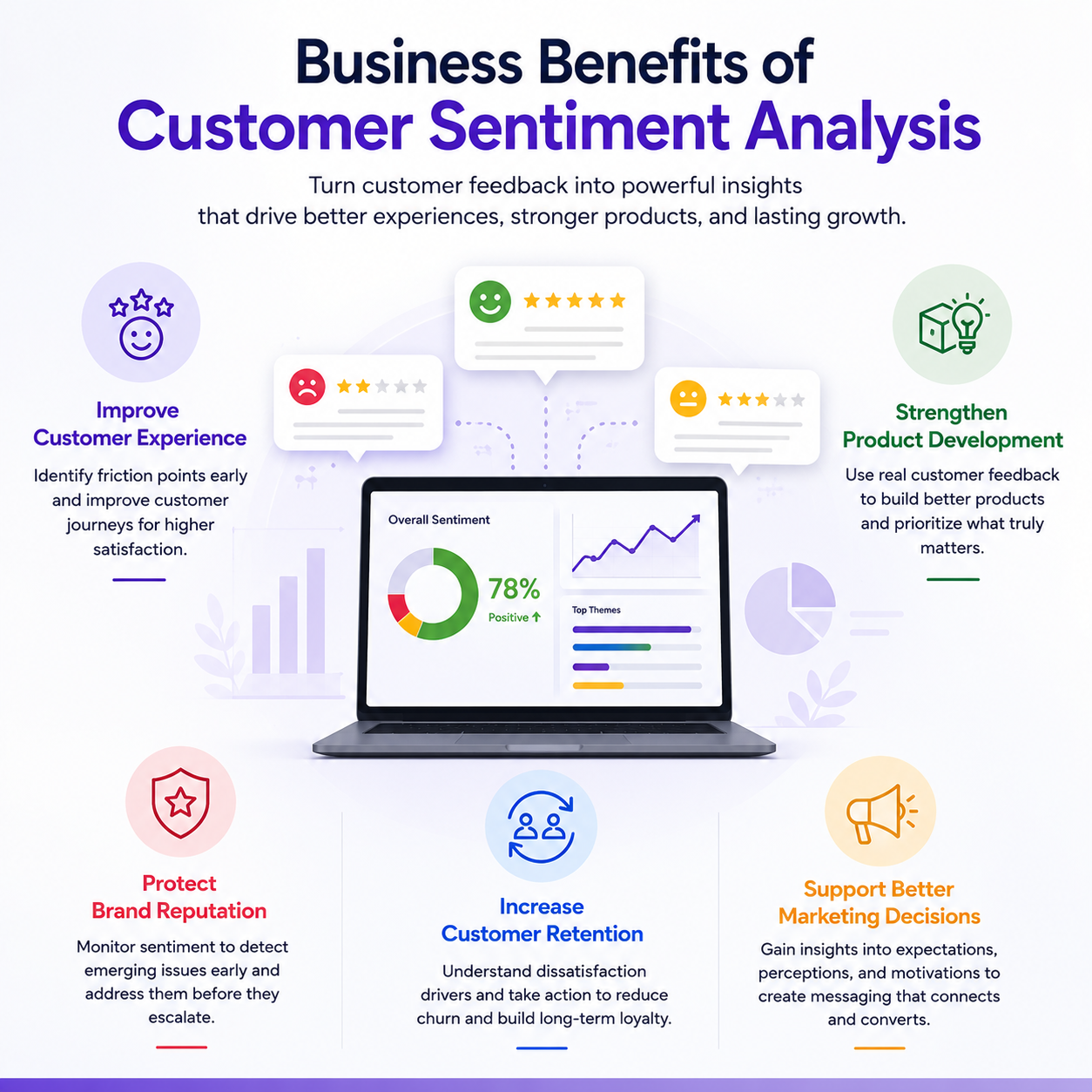
Organizations that consistently analyze customer sentiment gain a competitive advantage across multiple business functions.
Improve customer experience
Customer complaints often reveal friction points before they become larger problems.
Businesses can identify recurring service issues and improve customer journeys more quickly.
Strengthen product development
Customer feedback directly influences product innovation.
Instead of making assumptions, product teams prioritize features customers actually request.
Protect brand reputation
Monitoring online sentiment allows brands to detect emerging issues before they become public crises.
Negative trends can be addressed early through faster communication and service improvements.
Increase customer retention
Understanding why customers become dissatisfied enables businesses to reduce churn through targeted improvements.
Satisfied customers are more likely to remain loyal and recommend the brand.
Support better marketing decisions
Marketing teams gain insights into:
- Customer expectations
- Brand perception
- Purchase motivations
- Campaign effectiveness
These insights help create more relevant messaging and stronger customer engagement.
Turning Feedback into Actionable Business Insights
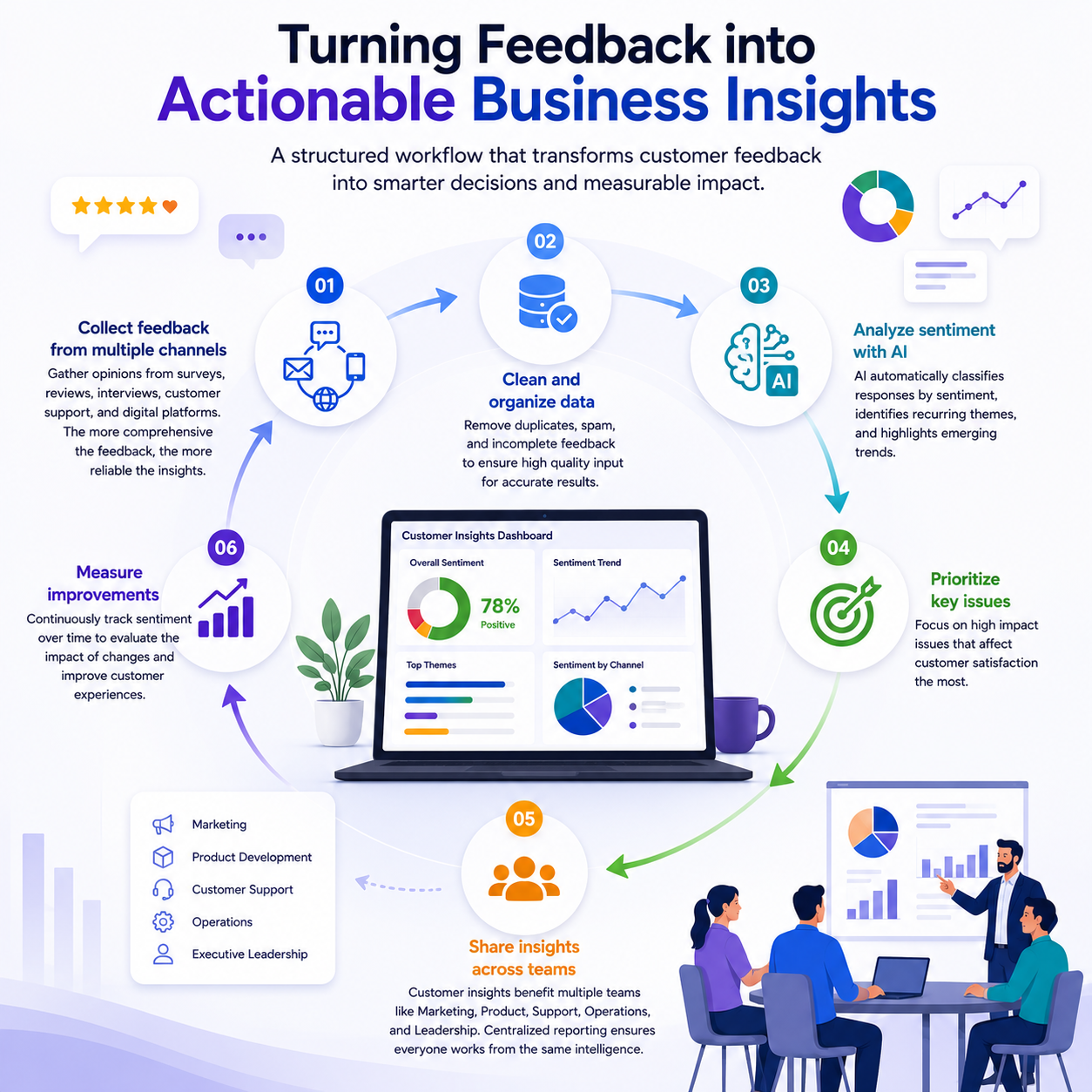
Collecting customer opinions only creates value when businesses translate findings into action.
A structured workflow typically includes the following steps.
Step 1: Collect feedback from multiple channels
Gather customer opinions from surveys, reviews, interviews, customer support, and digital platforms.
The more comprehensive the feedback, the more reliable the insights.
Step 2: Clean and organize data
Remove duplicate responses, spam, and incomplete feedback before analysis.
High quality input produces more accurate sentiment results.
Step 3: Analyze sentiment with AI
AI automatically classifies responses by sentiment, identifies recurring themes, and highlights emerging trends.
Step 4: Prioritize key issues
Not every negative comment requires immediate action.
Businesses should focus on high impact issues that affect customer satisfaction the most.
Step 5: Share insights across teams
Customer insights benefit multiple departments including:
- Marketing
- Product development
- Customer support
- Operations
- Executive leadership
Centralized reporting ensures every team works from the same customer intelligence.
Step 6: Measure improvements
Sentiment analysis should be continuous rather than a one time exercise.
Comparing customer sentiment over time helps organizations evaluate whether business changes actually improve customer experiences.
Real World Applications Across Industries
Customer sentiment analysis supports decision making across almost every industry.
Retail
Retail brands analyze product reviews to identify quality issues, pricing concerns, and shopping experience improvements.
Healthcare
Hospitals monitor patient feedback to improve service quality and patient satisfaction.
Financial Services
Banks analyze customer complaints to improve digital banking experiences and support services.
Technology
Software companies use customer feedback to prioritize product updates and identify usability challenges.
Consumer Goods
Brands evaluate product launch feedback to understand customer acceptance and optimize future innovations.
Regardless of industry, understanding customer sentiment allows businesses to make decisions based on evidence rather than assumptions.
Why AI Powered Research Platforms Deliver Better Results
General purpose AI tools can summarize text, but customer sentiment analysis requires deeper research expertise.
Market research involves understanding questionnaire design, respondent behavior, business objectives, and research methodologies.
Platforms like InsignAI combine AI with dedicated market research capabilities, allowing organizations to automate questionnaire design, survey execution, data quality management, text analytics, dashboards, and reporting within a single ecosystem. This integrated approach helps businesses move from raw feedback to business decisions much faster than traditional research workflows.
The result is faster research, standardized insights, improved consistency, and scalable decision making across enterprise teams.
Best Practices for Effective Customer Sentiment Analysis
Businesses achieve better outcomes by following a few proven practices.
- Collect feedback continuously instead of relying only on annual surveys.
- Combine quantitative scores with qualitative comments.
- Monitor sentiment trends over time rather than isolated responses.
- Validate findings with multiple customer segments.
- Share insights across departments instead of keeping reports within research teams.
- Use AI to automate repetitive analysis while allowing experts to interpret strategic findings.
- Continuously refine research questions based on customer feedback.
These practices help organizations build customer centric strategies supported by reliable evidence.
Conclusion
Customer feedback is one of the richest sources of business intelligence, but only when organizations know how to interpret it effectively. Reading individual comments is no longer enough in a world where businesses receive thousands of customer interactions every day.
Customer sentiment analysis allows organizations to understand customer emotions, identify emerging trends, prioritize improvements, and make faster, more informed decisions. With AI automating the analysis process, businesses spend less time organizing data and more time acting on meaningful insights.
As customer expectations continue to evolve, organizations that consistently transform feedback into strategic action will build stronger customer relationships, improve products, and stay ahead of the competition.
AI powered research platforms like InsignAI make this transformation possible by combining advanced sentiment analysis with end to end research automation, helping enterprises turn customer voices into confident business decisions.
Frequently asked questions
What is customer sentiment analysis?
Customer sentiment analysis uses AI to evaluate customer opinions and identify whether feedback expresses positive, negative, neutral, or mixed emotions while uncovering deeper themes and trends.
Why is sentiment analysis important for businesses?
It helps businesses understand customer experiences, improve products, strengthen customer loyalty, and make evidence based decisions faster.
How does AI improve customer sentiment analysis?
AI automates text analysis, detects emotions, identifies recurring themes, understands context, and processes thousands of responses significantly faster than manual methods.
Which industries benefit from customer sentiment analysis?
Retail, healthcare, finance, technology, consumer goods, hospitality, telecommunications, and many other industries use sentiment analysis to improve customer experiences and business performance.
Can customer sentiment analysis work with unstructured feedback?
Yes. Modern AI platforms analyze open ended survey responses, customer reviews, emails, social media comments, chat transcripts, and other unstructured data sources to generate actionable insights.
Ready to Transform Customer Feedback into Business Growth?
Whether you collect customer opinions through surveys, reviews, interviews, or support interactions, AI driven sentiment analysis helps uncover insights that traditional methods often miss.
Discover how InsignAI can help you automate customer feedback analysis and deliver actionable business insights faster.