

Someone leaves a five-star review for your product. Two days later, a different customer sends a support ticket saying the exact same feature that earned you that five-star review is why they're cancelling.
Both pieces of feedback are real. Neither one, on its own, tells you what's actually happening.
Multiply that by ten thousand responses across surveys, reviews, support tickets, and social comments. You now have a fairly accurate picture of what most research and CX teams are sitting with: a lot of data, a partial picture, and decisions that can't wait for someone to read through all of it.
Sentiment analysis tools exist to close that gap. Not by replacing the human judgment that makes research valuable, but by processing the volume of customer language that no team gets through manually, fast enough and consistently enough to inform decisions while they're still being made.
This piece covers what these tools are, how they work, what separates the good ones from the basic ones, and where they make the most concrete difference in practice.
What a sentiment analysis tool actually is
A sentiment analysis tool reads text, finds the emotional tone behind it, and classifies what it finds in a way that can be measured, tracked, and acted on.
At the basic level, that means positive, negative, or neutral. A customer says something good about your product: positive. They say something frustrated: negative. They say something that could go either way: neutral.
That basic classification is useful for getting a quick read on large volumes of text. It's also where most of the cheaper tools stop, which is why a lot of teams find sentiment analysis less actionable than they expected. Knowing that 34% of your NPS comments were negative doesn't tell you what they were negative about, which part of the experience triggered it, or whether it's getting better or worse.
More capable tools go further. They identify which specific aspect of the experience the sentiment is directed at. They detect the type of emotion behind the language, which is a different thing from the direction of the sentiment. They track changes over time. They work across multiple data sources at once rather than one at a time. And when they're built specifically for research rather than adapted from general-purpose AI, they understand how customers actually write in survey responses and reviews, which is different from the kind of language most AI models train on.
How sentiment analysis tools work
The underlying mechanism is natural language processing: the branch of AI concerned with teaching machines to read human language. The technique powering most modern sentiment tools is large language model classification, where a model trained on a large body of text learns to associate linguistic patterns with emotional states.
In practice, the tool isn't looking for specific keywords. It's reading context. "I wouldn't say this product is bad" is not a positive statement, even though it contains no negative words. "The team was incredibly helpful despite the product letting us down" holds positive sentiment about one aspect and negative sentiment about another, in the same sentence.
A rule-based tool that scans for positive and negative word lists handles neither of those well. A model trained on enough human language handles both reasonably. A model trained specifically on customer feedback language handles them better than a general one, because the way customers write in reviews and surveys follows patterns that differ from other kinds of text.
The output gets structured into something measurable: scores, classifications, theme labels, trend lines. That structure is what makes sentiment data useful rather than just interesting. The value isn't in identifying emotion in text. It's in counting it, comparing it across segments and time periods, and presenting it in a format where someone can see what it means and decide what to do next.
Features that separate good tools from basic ones
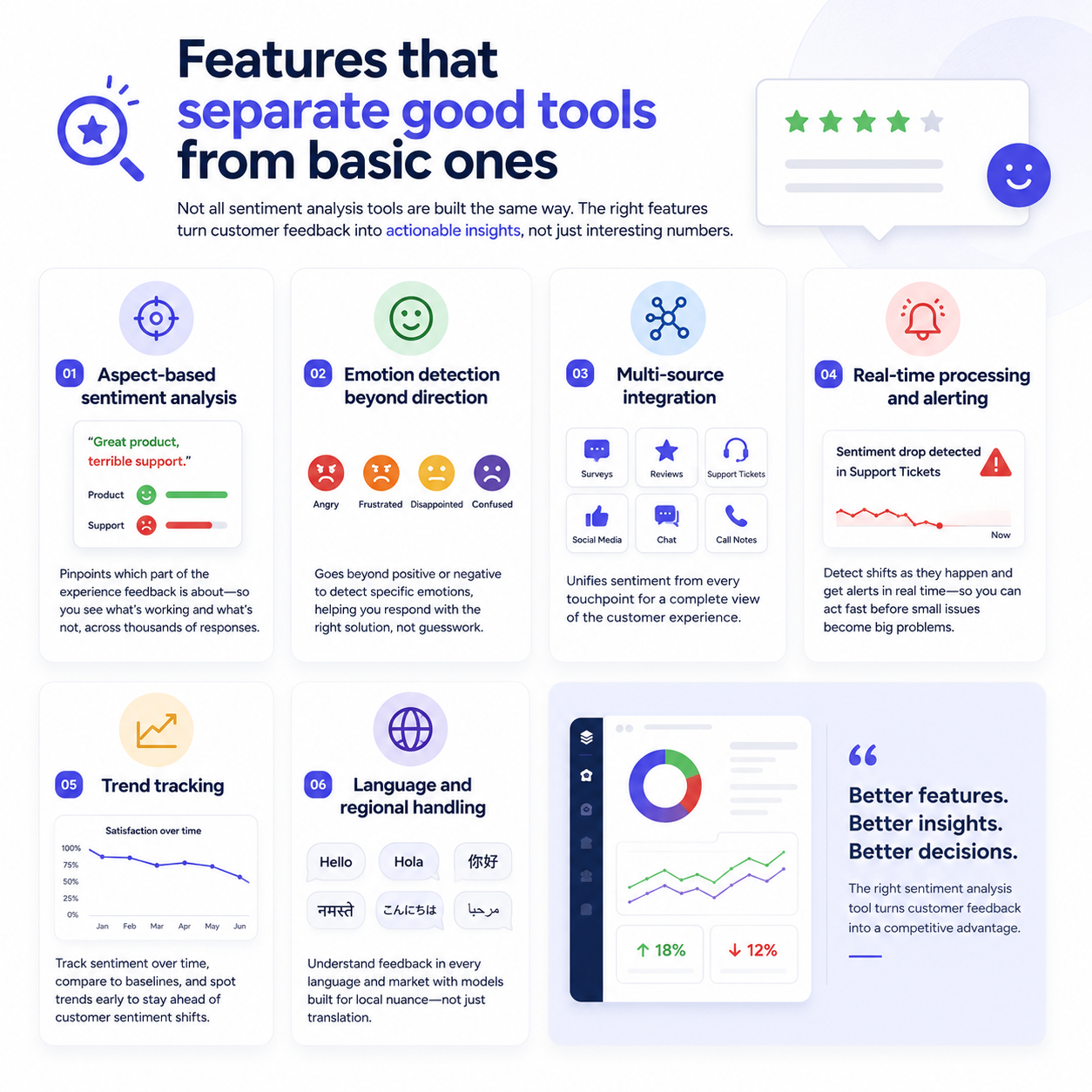
Not all sentiment analysis tools are built the same way, and the gap between a capable one and a basic one shows up quickly when you put them on real research data.
Aspect-based sentiment analysis
This is the feature that most separates tools producing actionable findings from tools producing interesting numbers.
Aspect-based sentiment analysis identifies which part of the experience a piece of feedback is actually about, not just whether it's positive or negative overall. "Great product, terrible support" is one piece of feedback with two distinct sentiments directed at two different parts of the business. A basic tool gives you one classification for the whole thing. An aspect-based tool gives you positive on product, negative on support.
Multiply that across thousands of responses and the difference becomes significant. You can see that product satisfaction is trending positive while support satisfaction is declining. You can see that pricing sentiment varies sharply by customer segment. You can see that onboarding frustration clusters among customers who signed up in a specific month, which lines up with a change your team made to the onboarding flow.
None of that is visible in a single overall sentiment score.
Emotion detection beyond direction
Positive and negative are directions. Emotions are states, and they're different things.
A frustrated customer and a disappointed customer are both negative, but they need different responses. A confused customer and an angry customer are both negative, but one is a product and training problem and the other is a service failure. Treating all four the same because the tool only reads direction means you're likely to misread all four.
Tools that classify by emotion type give you more specific signal to act on. "Confusion concentrated in the onboarding segment" points toward product and UX. "Frustration concentrated among long-term customers" is a different problem entirely. Bundling them into a single negative sentiment score hides both.
Multi-source integration
Customer language doesn't live in one place. Survey responses, NPS verbatims, app store reviews, social media comments, support tickets, chat transcripts, sales call notes: all of these contain sentiment data. Most tools analyze one source at a time, which means you get a picture of what customers said in your survey, or what they said in their reviews, but not a unified picture of both.
Tools worth using integrate across sources and apply consistent sentiment logic to all of them. The customer who gave you an eight on NPS but sent three frustrated support tickets the following month shows up as a concern in a unified view. In a survey-only view, they look fine.
Real-time processing and alerting
Sentiment reported six weeks after the data was collected is history. Sentiment tracked in real time is intelligence, and the difference matters most when something changes.
A product release goes out. A pricing change lands. A competitor makes a move. Tools that alert you when sentiment starts shifting in a specific segment, before the shift has time to compound, give you a chance to respond. Tools that batch-process and report monthly give you a very detailed account of what already happened.
Trend tracking
A single sentiment reading tells you where you are. Sentiment tracked over time tells you where you're heading.
The ability to compare current sentiment against a baseline, see whether a score is moving up or down, and identify when a shift started is what makes sentiment data predictive rather than just descriptive. "Satisfaction is at 72%" is a data point. "Satisfaction was at 78% three months ago and has been declining since the March update" is something you can act on.
Language and regional handling
Customer feedback comes in from different markets, in different languages, with different cultural registers for expressing satisfaction and dissatisfaction. A sentiment tool that only reads English accurately, or that applies sentiment logic calibrated on one market to data from another, introduces error that's invisible because the classification still produces numbers that look clean.
Tools built for global research programs use language-specific models calibrated for each market rather than translating everything into English and then running a single model. Translation introduces its own errors and loses the register information that matters for sentiment classification.
Where the concrete benefit shows up
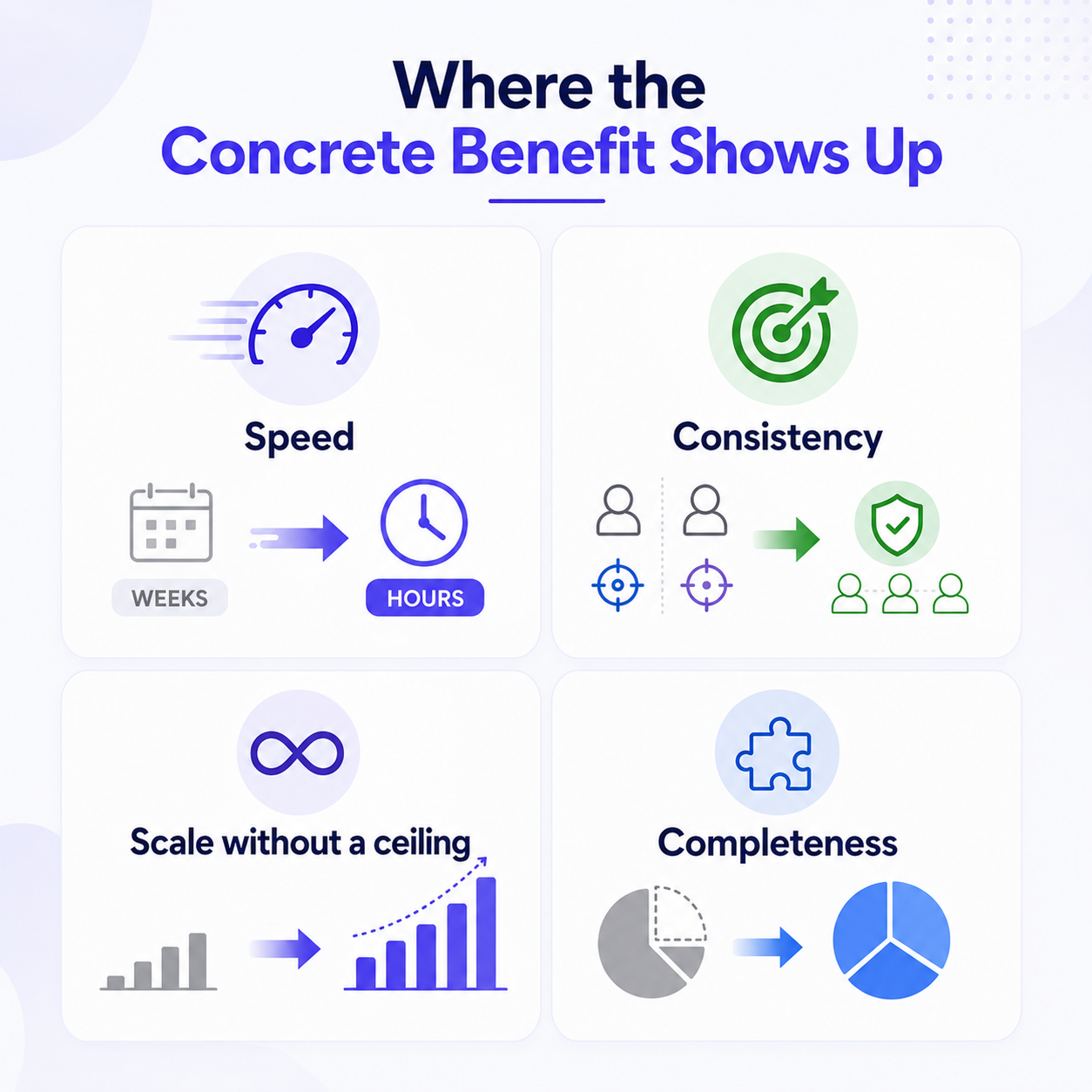
Speed
Manual analysis of open-ended feedback at meaningful scale takes weeks. AI-powered sentiment analysis takes hours for the same volume. For teams that need to close the loop between a product change and customer response before the next sprint, that speed difference changes what's possible, not just how efficiently the existing process runs.
Consistency
Two human analysts coding the same set of open-ended responses will not produce identical classifications. The same analyst coding on different days will not be perfectly consistent. Fatigue, frame-of-reference shifts, and prior hypotheses all affect how text gets categorized.
AI applies the same logic to the ten-thousandth response as it does to the first. That consistency matters when you're comparing sentiment across time periods or segments, because inconsistent classification introduces noise that looks like real signal.
Scale without a ceiling
Human analysis has a ceiling. Roughly thirty open-ended responses per analyst per hour is realistic for careful thematic coding. AI has no meaningful ceiling on volume. A study with 50,000 open-ended responses is not harder to analyze than one with 500. Sample size stops being a constraint on qualitative depth.
Completeness
Manual analysis of large open-ended datasets involves sampling. You read a portion of the responses, code the themes you find, and apply them across the rest. The themes you find are shaped by which responses you happened to read first and what you were already looking for.
AI reads everything. The theme that only appears in 4% of responses but is highly predictive of churn behavior doesn't get missed because no one happened to sample into it.
Use cases where it makes the clearest difference
Brand and reputation tracking
Brand perception shifts gradually and across many touchpoints. A quarterly tracker gives you four readings a year. By the time a reputation problem surfaces in a quarterly report, it has usually been building for months.
Continuous sentiment monitoring across reviews, social content, and survey responses gives you a picture that updates regularly. You see the shift when it starts, not six weeks after it has compounded into something harder to reverse.
Product development and launch monitoring
Product teams need feedback on what they ship fast enough to adjust before the next release cycle. Sentiment analysis on post-launch survey responses, app reviews, and support ticket language gives product teams a read on how specific features are landing, which customer segments are struggling, and where usability problems are clustering, in days rather than weeks.
Customer experience measurement
CX sentiment doesn't live in one survey. It lives in post-purchase feedback, NPS verbatims, support interactions, and churn interviews. Analyzing each separately gives you partial pictures. Unified sentiment analysis across all of them surfaces customers whose survey scores and support behavior point in opposite directions before they become churn statistics.
Market research and consumer insight
In a research context specifically, sentiment analysis tools are most useful when they're integrated into the full research workflow rather than bolted on at the end. Questionnaire design that builds in open-ended questions suited to sentiment extraction, fieldwork that monitors response quality in real time, and analysis that processes structured and unstructured data together: this is what a purpose-built research platform does that a standalone sentiment tool doesn't.
Internal and employee feedback
The same capability applies internally. Employee survey verbatims, engagement feedback, pulse survey open ends: these carry signal that numeric scores don't capture. Organizations using sentiment analysis on internal feedback get earlier warning of engagement problems and more specific information about what's driving them.
What to look for when evaluating these tools
A few questions worth asking before committing to a platform.
Is it trained on domain-specific data, or is it a general-purpose model applied to research? The difference shows up in how well it handles the way customers actually write in surveys and reviews versus how language appears in general text.
Does it do aspect-based classification or just positive/negative/neutral? If the answer is just the three buckets, the output will tell you a problem exists without telling you what the problem is.
Can it process multiple data sources in a unified framework, or does it analyze each source separately? Separate analysis produces separate pictures. Unified analysis produces a complete one.
Does it track sentiment over time with comparable methodology, or does each analysis run independently? Trend analysis only works if the methodology is consistent enough to make period-over-period comparisons meaningful.
How does it handle multilingual data? If your customer base spans markets and languages, the answer to this question matters more than most of the feature marketing suggests.
Frequently asked questions
What is the difference between sentiment analysis and opinion mining?
The terms get used interchangeably, but there's a useful distinction. Sentiment analysis is the broader category: reading emotional tone in text. Opinion mining is more specific: identifying what the opinion is about, who holds it, and which aspect of the subject it targets. Aspect-based sentiment analysis is essentially opinion mining inside a sentiment tool. A basic sentiment tool tells you a response is negative. A tool that does opinion mining tells you it's negative about the onboarding flow, from a customer in the SMB segment, in their third month of subscription.
How accurate are sentiment analysis tools?
Accuracy varies by tool and by the type of text being analyzed. General-purpose models applied to customer feedback typically perform well on clearly positive or clearly negative language and struggle with sarcasm, mixed sentiment, cultural register differences, and the understated dissatisfaction that shows up frequently in survey responses. Domain-specific models trained on customer feedback language handle these cases better. Most capable tools report accuracy rates in the 85 to 90 percent range on well-defined classification tasks. The more useful question for practical purposes is whether the output is consistent and specific enough to drive decisions, which depends more on the tool's structure than on headline accuracy numbers.
Can sentiment analysis tools handle multiple languages?
Some do, some don't. Tools built for global research programs typically include multilingual models calibrated for each language rather than relying on translation before analysis. Translation introduces its own errors and loses register information that matters for sentiment classification. If your research spans multiple markets, verify that multilingual capability means language-specific models rather than translation plus a single English-trained model.
How is sentiment analysis different from text analytics?
Text analytics is the broader category: extracting structured information from unstructured text. It includes sentiment analysis but also covers theme extraction, entity recognition, keyword frequency, and other forms of text processing. Sentiment analysis focuses specifically on emotional tone and opinion. A text analytics platform usually includes sentiment analysis as one capability among several. For research purposes, you typically want both: theme extraction to identify what customers are talking about, and sentiment classification to understand how they feel about it.
What data sources can sentiment analysis tools process?
The more capable ones handle survey open ends, NPS verbatims, app store reviews, social media comments, support ticket text, chat transcripts, and interview transcripts. Each source has different language characteristics and needs some calibration. Survey responses tend to be more considered than social media comments. Support tickets tend to be more emotionally charged than NPS responses. A tool that applies identical processing to all of them without accounting for these differences will produce less accurate results than one that handles source-specific language patterns.
Do you need a large volume of data for sentiment analysis to be useful?
Useful, no. Reliable, it depends on the question. Sentiment classification works on individual responses and can surface themes from relatively small datasets. Where volume matters is in the reliability of trend analysis and segment comparisons. Comparing sentiment between two customer segments with fifty responses each is possible but produces wide confidence intervals. The same comparison with five hundred responses per segment is considerably more reliable. For most research programs, the floor for meaningful segment-level sentiment analysis sits somewhere between 100 and 200 responses per segment, though this depends on the homogeneity of the segment and how subtle the effect you're trying to detect actually is.
InsignAI is a full-stack, AI-native market research platform with a dedicated Market Research LLM, built to turn customer language into decisions your team can act on the same day.