

Here's a problem that doesn't get talked about enough in research circles.
You spend two weeks designing a survey. It goes through three rounds of internal review. Stakeholders sign off. The questionnaire goes live. Two thousand responses come in. The data gets cleaned. The analysis gets built. The deck goes to the client.
And somewhere in the debrief, someone asks: "Why do you think respondents interpreted this question that way?"
The honest answer, the one nobody says out loud, is that the question was always going to be interpreted that way. The wording was ambiguous. The scale didn't match what was being measured. The question order primed respondents to answer differently than they would have otherwise. The problem was baked in before a single response came in.
Bad questionnaire design is the most expensive mistake in market research because it's the one you can't fix after the fact. You can clean bad data. You can reweight a sample. You cannot go back and redesign the instrument once 2,000 people have answered it the wrong way.
This is the problem AI is now genuinely solving, before fieldwork begins rather than after it ends.
Why survey design is harder than it looks
Anyone who has built a survey from scratch knows the gap between a question that seems fine in a Word document and one that performs well in field.
A question that reads clearly to the researcher who wrote it can confuse a respondent who comes to it with different context. A scale that feels intuitive to someone who thinks about research every day can feel completely arbitrary to someone filling out a survey on their phone between meetings. A question order that makes logical sense to the analyst can prime respondents in ways that systematically skew every answer that follows.
These aren't edge cases. They're the default. Questionnaire design is a specialist skill that takes years to build, and even experienced researchers make choices they later regret when the data comes back looking strange.
The traditional fix has been review. Multiple rounds of it. Internal methodologist review. Client review. Pilot testing. A soft launch on a small sample before full fieldwork begins. All of these help catch things. None of them catch everything, because the people reviewing a questionnaire bring the same assumptions the people who wrote it did. They've read it so many times that the ambiguous question no longer reads as ambiguous. The leading phrasing sounds neutral by the fourth pass. The double-barreled item somehow makes it through again.
AI doesn't have those assumptions. It doesn't have familiarity bias. It doesn't get tired of reading the same question. It approaches a questionnaire fresh every time, which is exactly the problem with human review that nobody has a good solution to.
What AI brings to questionnaire design
An AI trained specifically on market research methodology reviews a questionnaire the way a very experienced, very fresh-eyed methodologist would, without the blind spots that come from being too close to the project, too familiar with the research objective, or too attached to the question wording that took two days for the team to agree on.
Here's where it makes the most concrete difference.
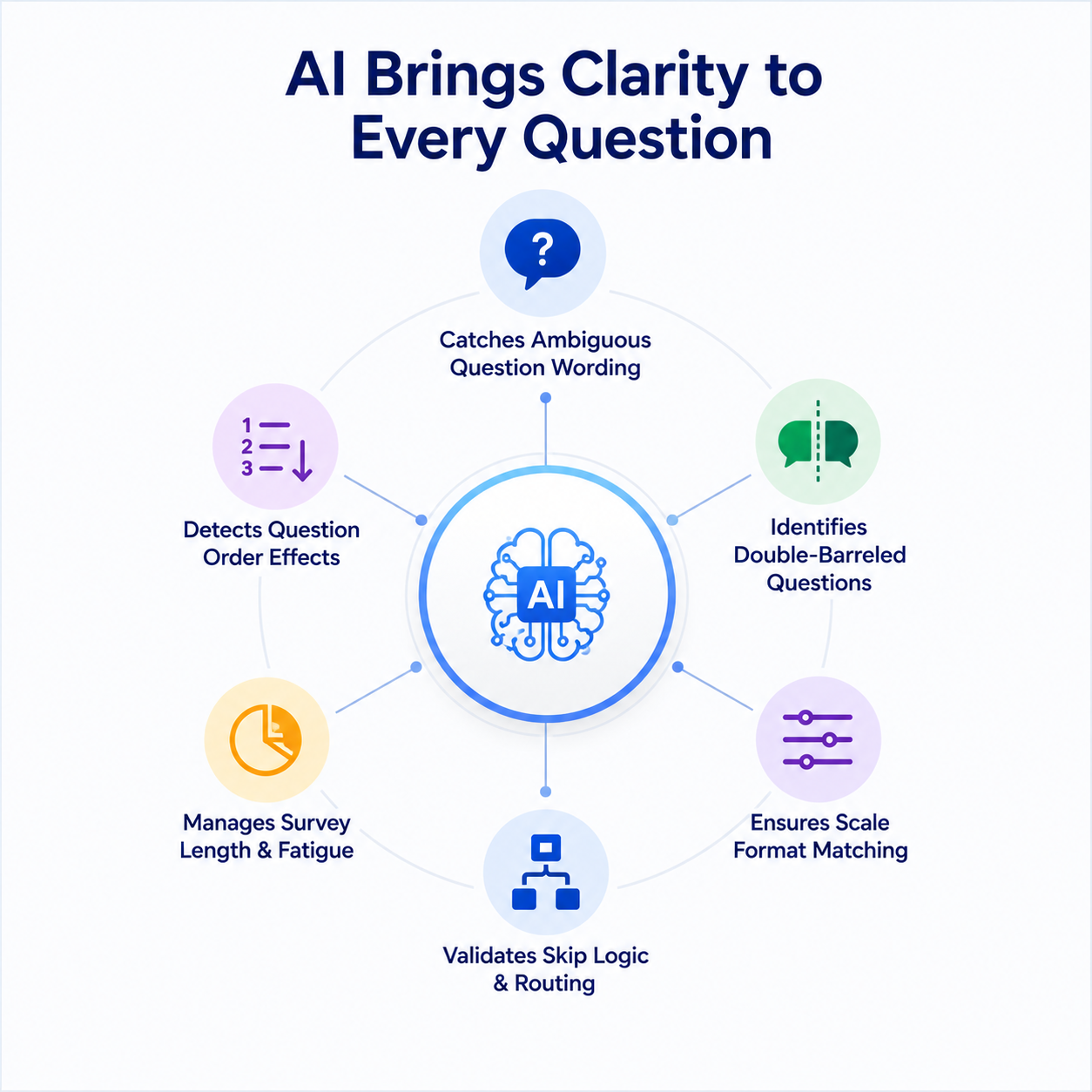
Catching ambiguous question wording
The most common source of bad survey data isn't dishonest respondents. It's questions that different respondents genuinely interpret differently.
"How often do you purchase premium products?" sounds fine. But "often" is relative. "Premium" means something different depending on who's answering. "Purchase" may or may not include online orders, subscription renewals, or purchases made by someone else in the household. Two respondents can answer the exact same question with completely different things in mind, and the data will look clean while meaning very little.
AI flags these ambiguities before they reach field. It identifies words and phrases that carry different meanings across different respondent groups, suggests clearer alternatives, and catches the interpretive gaps that human reviewers miss precisely because they've read the question so many times that it stopped registering as a problem.
Identifying double-barreled questions
A double-barreled question asks about two things at once and forces one answer for both. "How satisfied are you with the price and quality of the product?" A respondent who loves the quality and hates the price has no correct answer. Whatever they pick misrepresents at least half of what they actually think, and the resulting data reflects neither opinion accurately.
These questions appear in surveys more often than researchers would like to admit, because they look perfectly reasonable on a first read. AI catches them reliably and flags them for splitting into separate items that produce data you can actually interpret.
Scale format matching
Not all constructs should use the same scale. Frequency questions, agreement questions, and satisfaction questions each perform better with different formats. Using a five-point agreement scale to measure frequency behavior introduces measurement error. So does a ten-point scale where a five-point scale would do, or an odd-point scale for a construct that's inherently bipolar.
All of these choices introduce error that shows up in the data without an obvious explanation, usually blamed on the sample or the respondents rather than the instrument. AI trained on research methodology knows which scale formats work for which constructs and flags the mismatches before they affect the data. Experienced methodologists do this check instinctively. Junior researchers often don't know to do it at all.
Question order effects
The order questions appear in a survey affects how respondents answer them. This is well established in methodology research and persistently underaddressed in practice, because fixing order effects requires thinking through the questionnaire as a whole system rather than reviewing each question in isolation.
Asking respondents about overall brand satisfaction before asking about a recent negative experience produces different satisfaction scores than asking in the reverse order. Asking about price sensitivity after a long battery of feature questions produces different results than asking about it early. These aren't small differences. They can shift findings enough to change the strategic read on the research entirely.
AI evaluates the full sequence, not just individual items. It identifies where ordering is likely to prime responses, where sensitive questions should be moved to reduce social desirability bias, and where the logical flow breaks down in ways that increase drop-off before the survey is complete.
Survey length and fatigue
Respondent fatigue is one of the most underappreciated sources of data quality problems in survey research. The answers someone gives to questions forty through sixty are not the same quality as what they gave to questions one through twenty. Attention drifts. Straight-lining increases. Open-ended responses get shorter and less specific, which is particularly damaging because the open ends are usually where the most valuable qualitative data lives.
AI estimates cognitive load across the full questionnaire based on question type, complexity, open-ended volume, and the characteristics of the target audience. It flags where fatigue is likely to set in, identifies sections where question density is too high, and warns when the overall length is likely to hurt completion rates for specific respondent types. Not a precise per-respondent forecast, but a meaningful early warning that the instrument is pushing beyond what a realistic respondent will engage with carefully.
Skip logic and routing validation
Complex surveys with multiple audience segments, branching paths, and skip logic are genuinely difficult to validate manually. A routing error that sends a respondent to the wrong question path produces data gaps that only become apparent during analysis, at which point there's nothing to be done about them.
AI validates routing logic across every possible path through the survey. Manual review focuses on the main respondent journey and regularly misses the edge cases where an unusual combination of answers sends someone somewhere unintended. AI tests every branch, catches the inconsistencies, and flags the questions where a routing error would create gaps or expose respondents to questions that have no bearing on their situation. Comprehensive path validation on a complex multi-segment survey is practically impossible to do manually. It's routine for AI.
Beyond design: what AI does during fieldwork
The design review is the most significant thing AI brings to survey quality. It's also not the end of what AI can do.
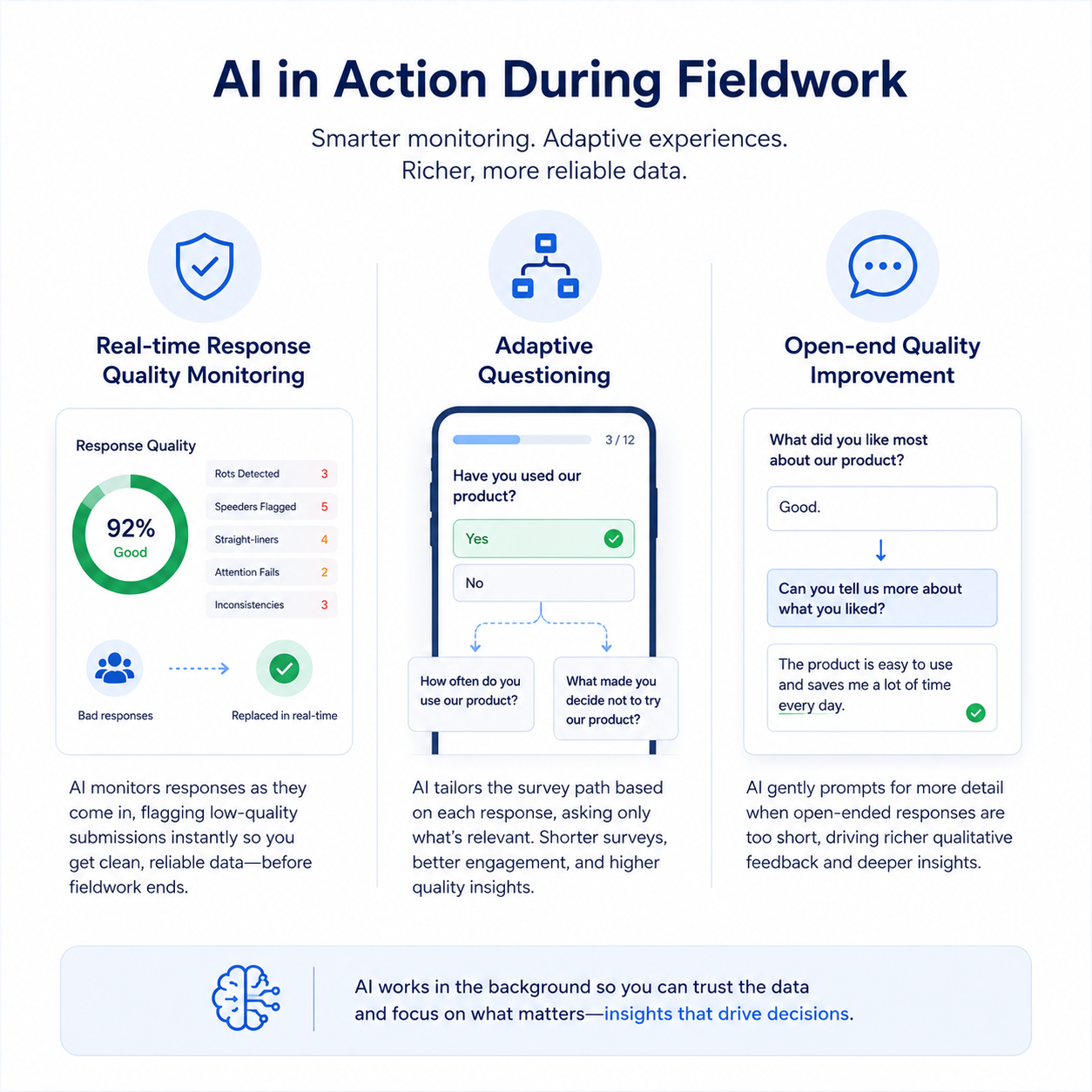
Real-time response quality monitoring
Traditional data quality checks happen after fieldwork closes. By then, the problematic responses are already in the dataset. They've been collected and paid for, and removing them means going back into field to replace the sample, which costs additional time, money, and often pushes the analysis timeline back by a week.
AI-powered platforms monitor response quality throughout fieldwork. Bot detection, speeder flagging, straight-liner identification, attention check failures, response inconsistencies across related questions: all of it gets flagged as responses come in. Bad responses are replaced before fieldwork closes, which means the dataset that comes out the other end is already clean rather than requiring a separate cleaning step.
Adaptive questioning
A static survey asks everyone the same questions regardless of what they've already said. An adaptive survey, which AI makes possible at scale, adjusts the question path based on responses as they arrive. A respondent who indicates they've never used a product category doesn't receive a long battery of usage questions. A respondent who gives a highly negative satisfaction rating gets a follow-up probe that explores what's driving it rather than moving on as if the score hadn't just flagged something important.
This produces richer data from the same number of questions because each respondent's survey is actually relevant to their experience. It also reduces perceived length, because respondents aren't wading through questions that clearly have no bearing on their situation. Both effects improve data quality: more relevant questions produce more thoughtful answers, and shorter perceived surveys produce less fatigue-driven noise in the later sections.
Open-end quality improvement
Open-ended responses are where the most useful qualitative insight lives. They're also the most vulnerable to low-effort answers. "Good." "Fine." "N/A." Single-word responses that tell you nothing happen when respondents feel the question isn't worth the effort or when they're fatigued enough that they just want the survey to be over.
AI can prompt respondents who give insufficient open-ended responses to add more detail, in real time, in a way that doesn't feel heavy-handed or push them into giving answers that aren't genuine. A light, natural prompt after a one-word response produces meaningfully richer qualitative data than accepting the low-effort answer and hoping the analysis team can work with a wall of "good" and "fine" responses.
What better design actually does to research quality
The downstream effect of catching these problems before fieldwork isn't just cleaner data. It's more accurate findings.
Every design flaw in a questionnaire introduces systematic error into the dataset. Ambiguous questions produce inconsistent responses that look like variance but are really noise. Double-barreled questions produce uninterpretable data that requires the analyst to make guesses about what respondents meant. Order effects shift findings in ways that don't reflect what customers actually think. Fatigue-driven straight-lining in the back half of a survey flattens the variance that makes segmentation meaningful.
When AI catches these issues before fieldwork rather than after, the data that comes back more accurately reflects what respondents actually think and feel, rather than what the questionnaire design inadvertently steered them toward. That's not a marginal quality improvement. It's the difference between research that holds up when someone asks a hard question in the debrief and research that quietly unravels.
It also changes how methodologist time gets used. When AI handles the systematic checks, the human methodologist's attention goes toward the judgment calls that actually require expertise: whether the research design is answering the right business question, whether the findings connect to the decision that needs to be made, whether something unexpected in the data is a real signal or an artifact. That's a better use of methodological expertise than spending two hours per project hunting for double-barreled questions and mismatched scales.
The cost nobody tracks
Research teams almost never track the cost of bad survey design explicitly. The project ran. The data came back. The deck got delivered. The fact that three questions were ambiguous and two had order effects that distorted the key findings doesn't show up in the debrief. It shows up months later in a product decision that was made on data that was subtly wrong, and by then the connection is completely invisible.
The case for AI-powered survey design isn't just faster research. It's more reliable research. Findings that hold up under scrutiny. Recommendations grounded in data that reflects what customers actually think rather than what the questionnaire inadvertently produced. That difference is hard to put a number on until you've seen what it costs to make a significant strategic decision on flawed data.
Research should drive decisions, not decorate them. Better survey design is what makes that possible.
Frequently asked questions
How does AI improve survey question wording?
AI trained on research methodology reviews question wording for specific design problems before the survey goes into field: ambiguous language that different respondents will interpret differently, double-barreled questions that bundle two issues into one response option, leading phrasing that pushes respondents toward a particular answer, and jargon that's clear to the research team but confusing to the target audience. It flags these and suggests alternatives. This is more reliable than human review alone because it doesn't carry the familiarity bias that builds up after weeks of working on the same questionnaire.
Can AI really detect when a survey is too long?
Yes, with reasonable accuracy. AI trained on research methodology estimates cognitive load across a questionnaire based on question type, complexity, the volume of open-ended items, and the characteristics of the target audience. It identifies where fatigue is likely to set in and flags sections where the density or sequencing of questions is likely to affect response quality in the back half of the survey. It won't give you a precise per-respondent completion forecast, but it gives you a meaningful warning that the questionnaire is pushing beyond what a typical respondent will engage with carefully.
What are question order effects and why do they matter?
Question order effects happen when the sequence of questions in a survey systematically influences how respondents answer later ones. Asking about overall brand satisfaction before a recent negative experience produces different scores than asking in reverse order, because the negative experience is now top of mind when the satisfaction question arrives. These effects are well-documented in research methodology and routinely underaddressed in practice because catching them requires evaluating the full questionnaire as a system rather than reviewing questions individually. AI evaluates the complete sequence and flags where order is likely to skew findings.
How does AI handle skip logic and routing errors?
By testing every possible path through the questionnaire rather than only the most common ones. Manual review of skip logic focuses on the main respondent journey and misses the edge cases where an unusual combination of answers sends someone down an unintended path. AI validates every branch against the intended routing logic, catches inconsistencies, and flags questions where a routing error would create data gaps or expose respondents to questions that don't apply to them. Comprehensive path validation on a complex survey is practically impossible to do manually. AI does it routinely.
Does AI-powered survey design replace methodologists?
No. It changes what methodologists spend their time on. The systematic checks AI handles, question wording review, scale format validation, order effect analysis, routing logic testing, currently consume a significant portion of methodologist time on every project. When AI handles those checks, the methodologist's attention goes toward decisions that require real judgment: whether the research design is answering the right business question, how to interpret unexpected findings, how to communicate nuanced results to stakeholders who need to act on them. Most researchers find that shift a better use of their time. The risk is for teams that treat methodological review as a box-checking exercise rather than a genuine quality function, because AI makes it easier to skip the human judgment step entirely, which is the wrong conclusion to draw.
What's the difference between piloting a survey and using AI for design review?
Piloting tests the survey on a small live sample to catch problems before full fieldwork. AI design review catches problems before any sample is involved. Both have value, but they catch different things. Piloting identifies questions that produce unexpected response distributions or that respondents flag as confusing in real conditions. AI review identifies structural design flaws in the instrument itself. Both should happen: AI review improves the instrument before piloting, and piloting validates that the improved instrument performs as expected in field. Running only a pilot without AI review means discovering fixable problems at the cost of a small sample. Running only AI review without a pilot means not testing how the instrument performs with real respondents. The combination produces better results than either does alone.
InsignAI is a full-stack, AI-native market research platform with a dedicated Market Research LLM, built to catch the problems that contaminate data before they ever reach field.